





Rising Solid State Drive Prices and the Effects on Our Industry

Rising Solid State Drive Prices and the Effects on Our Industry


For transportation providers, onboard video systems remain essential for safety, accountability and fleet oversight. But new challenges have emerged that many fleet managers didn’t anticipate: rising solid state drive prices and limited availability of NAND flash memory.

Solid state drives (SSDs) used in mobile DVRs rely on NAND flash components that are now costlier and more difficult to obtain. Research reported by CNBC indicates this isn’t a short-term fluctuation. As a result, fleet operators must reassess their video storage strategy to adapt to the ongoing shortage and to help control costs.


What’s Behind the Shortage?

The underlying cause is simple: demand is surpassing supply.

The rapid expansion of AI-driven data centers and cloud infrastructure demands unprecedented volumes of NAND flash memory, a key component in SSDs. Large technology companies are investing heavily in storage to support their AI and high-performance computing. In response, International Data Corporation notes that memory manufacturers have shifted production for consumer electronics toward memory used in AI data centers. This leaves limited supply available for other industries, including transportation.


How Memory Shortage Impacts Fleet Operations

The impact is twofold.

First, solid state drive prices are climbing. As NAND memory becomes more expensive, so do the storage devices used in mobile video systems.

“While we work to minimize pricing increases wherever possible, REI must remain aligned with current market conditions. Storage costs, in particular, have continued to rise above initial expectations. These challenges are not unique to REI, as they are impacting suppliers and providers across all industries,” notes Riley Hays, REI’s Sales Operations Manager.

Second, procurement timelines are increasing. Lengthy production timelines for memory chips and wafer bonding are further compounding the shortage. When combined with the limited number of memory manufacturers, these factors create significant procurement delays, adding strain to an already tight supply chain.

REI’s component supplier indicates that all NAND flash output for 2026 and 2027 is already committed. Demand is expected to remain high through 2027, according to NAND-Research.com. For fleet operators, this means ongoing pricing pressure and sourcing delays for storage hardware.


How Fleets Can Adapt to Rising SSD Prices 

Fleets may realize shortage effects quickly and operationally. Higher solid state drive prices can negatively impact budgets, especially for operations expanding or upgrading their video systems across fleets. Procurement delays can also slow or halt installations, causing gaps in coverage. To help reduce the impact on your operation, consider alternative storage approaches.

Some systems are configured to record and retain full days of continuous video across every vehicle. While this approach is thorough, it creates a significant storage burden. Hours of uneventful footage deplete valuable space and intensify hardware demands. At a time when storage is expensive and constrained, this practice is not cost-effective.

REI offers these two tips to help you reduce storage demands for your operation:

1. Integrate ARMOR™ Software Suite

Rather than expanding storage to retain all footage, reduce storage demands by changing how you manage video. REI’s ARMOR™ Software Suite is designed with that goal in mind.

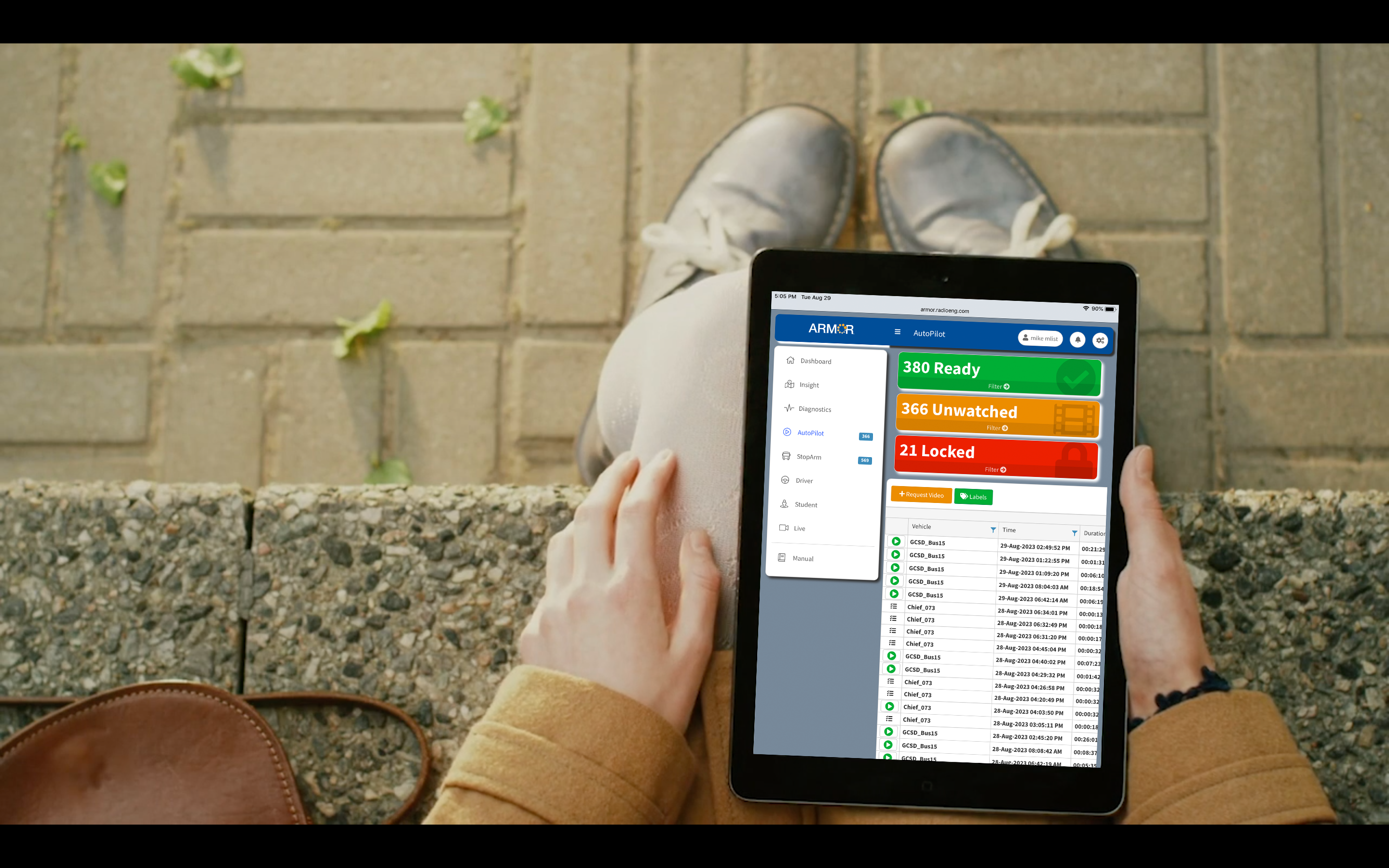
The suite automatically downloads flagged video clips from your fleet DVRs and stores them indefinitely in the optional ARMOR Cloud. You save only the clips that matter versus an entire day’s footage. This significantly reduces storage space.

By storing less unnecessary data, you can use smaller, lower cost hard drives without compromising your ability to capture and retain critical events. Review your state’s requirements for video retention. ARMOR and the cloud could be a cost-effective option.

2. Rethink SSDs

As solid state drive prices rise, REI suggests operations revisit their long-held assumptions that SSDs are more reliable than spinning disk drives (HDDs). It’s true that SSDs lack moving parts, but in mobile environments, reliability isn’t determined by that factor alone.

In fleet applications, REI believes dust, moisture and vibration are the leading causes of HDD failure. If these factors aren’t properly addressed, any storage medium is at risk. That’s where design and engineering become critical.

To counter these elements, REI designs fully sealed hard‑drive enclosures and fanless DVRs that minimize dust and moisture exposure. We also engineer these spinning-disk enclosures to minimize vibration on the drives. In these controlled environments, spinning disk drives can deliver reliability comparable to SSDs, allowing you to attain similar performance at a lower cost.


Planning Ahead for Higher Solid State Drive Prices 

Demand for NAND flash memory isn’t expected to slow down anytime soon, according to the HP Workforce Experience. As AI infrastructure continues to expand, competition for storage resources will remain intense.

For transportation operations, that means adapting, not simply paying higher SSD prices. A smarter path forward is to improve your storage efficiency by implementing cloud-based solutions and the right hardware versus simply adding capacity. You can then optimize performance and maintain greater control over costs.

Let us help you choose the right solutions to mitigate storage issues within your operation. Talk to your REI sales rep or contact us to start the conversation. Together, we can keep your operation moving forward.


Cloud-Based Fleet Management Software Should Include ARMOR Cloud

Cloud-Based Fleet Management Software Should Include ARMOR Cloud

armor

Here’s why.

Today’s cloud-based fleet management software captures volumes of information. It also demands server management and data storage capabilities. However, bus operations may lack the know-how and IT infrastructure. The answer: a cloud service.

Reliance on the cloud for data storage continues to grow. Why? Because companies want to capitalize on its many benefits. In fact, the cloud offers so many benefits it is used to store most corporate data.

Among the corporate data are fleet analytics and bus camera system video from REI’s ARMOR™ Software Suite. Many ARMOR customers (64%) use REI’s optional ARMOR Cloud, a cloud service, for data storage and server management. Why should you choose it for your ARMOR cloud-based fleet management software? Read the ten reasons outlined below.

1. ARMOR Cloud saves and backs up data and video.

ARMOR Software Suite generates vast amounts of data, plus video from REI cameras. It could be lost or damaged during electrical storms and power outages. With this in mind, ARMOR Cloud backs up your server.

2. 24/7/365 access to fleet management surveillance video and data.

ARMOR Cloud permits nonstop access to downloaded data and video from your ARMOR fleet management software. Even more, internet-connected devices enable access from anywhere.

Taylor Moore, ARMOR product and engagement manager, explains, “ARMOR engages several modules and data collected by sensors, hardware, and automation. This prompts notifications, reports, and video. Accessing this information in a timely manner speeds up everything. What’s more, administration can become more efficient and effective in safety, fleet health, and operations management. Overall, the service benefits every member of a district, including students, in some way.”

ARMOR_SanteFeISD

Access your ARMOR server 24/7.

3. Transition to the cloud is easy.

ARMOR Cloud is turnkey. In other words, it transfers data and video from your REI bus DVR to the cloud for you.

4. Easy to learn.

Cloud computing requires a short learning curve. In fact, ARMOR Cloud users only need a few steps to log in to their ARMOR servers.

5. Convenience and security.

REI’s IT staff manages your ARMOR Software Suite server. This includes scalability, software updates, and security. In short, ARMOR Cloud eliminates or reduces server duties for your IT resources.

6. Save money.

REI’s ARMOR Cloud service stores and manages fleet statistics and videos from your bus camera systems for you. Therefore, the service reduces IT needs. For this reason, you save some staff and hardware costs.

ARMOR™ Cloud logo

Simplify fleet video management with ARMOR Cloud.

7. Save time.

Your cloud-based fleet management software collects a lot of data and video. ARMOR Cloud service provides the server and manages the information for you. Basically, it frees up time for you and your IT staff. As a result, you have more time to do other key tasks.

8. Greater peace of mind.

Rest easier knowing pros take care of your server. Consequently, they lighten your workload and help ensure peak server performance. Therefore, you stress less.

9. Less responsibility.

REI manages your server’s size and upgrades. Hence, fewer responsibilities for you and your staff.

10. Maximized uptime.

ARMOR Cloud service tracks server performance and makes sure your server works properly. Reliable performance means increased uptime and less downtime. Overall, your operation becomes more efficient.

As has been noted, ARMOR Cloud eases fleet video management in many ways. To learn more about this cloud service, request information or a demo. Moreover, see how it could enhance your cloud-based fleet management software.

To summarize, Moore adds, “If there’s one word that sums up ARMOR Cloud, it’s accessibility. The service provides remote access to your fleet data and video, 24/7/365. It’s a real game-changer for time-strapped bus operations.”

Billions of users now rely on the cloud. On the whole, it makes their work easier. Cloud computing with ARMOR Cloud service can do the same for you, too.

REI Receives Award at Bus Technology Summit

REI Receives Award at Bus Technology Summit